

As responsible investors, we’ve spent years building our capability to assess climate risk, human rights issues across supply chains, and governance quality. First Nations rights warrant the same analytical rigour — and while the materiality has always been there, the frameworks to assess it consistently have not. Over the past eight months, we’ve been working to change that.
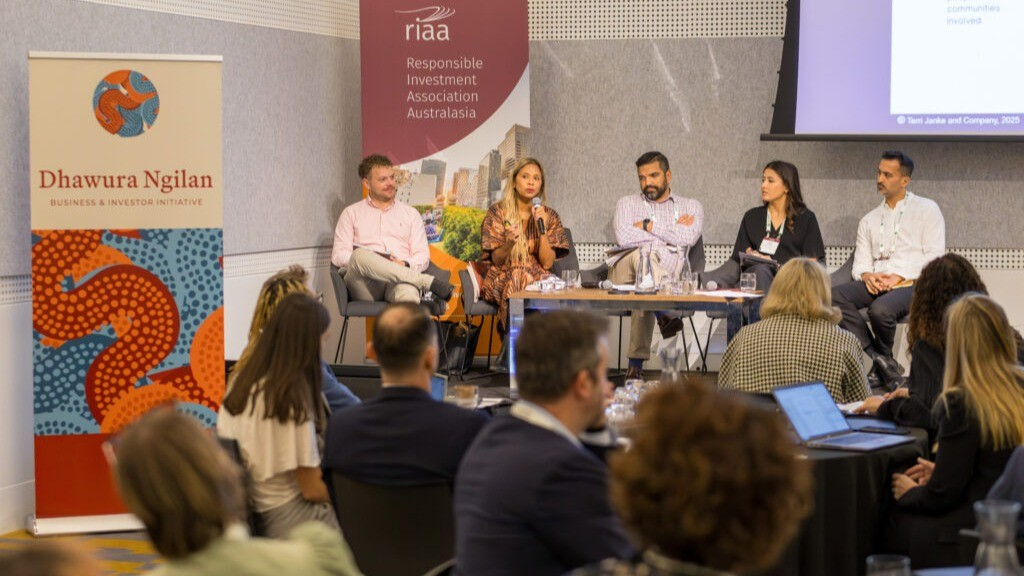
In September 2025, Alphinity joined the Dhawura Ngilan Business and Investor Initiative (DNBII) as a pilot partner. Dhawura Ngilan means “Remembering Country”. The DNBII Principles and guide are a First Nations-led framework, built around 20 principles across six pillars, designed to help businesses and investors protect Aboriginal and Torres Strait Islander cultural heritage. We joined the pilot alongside investors including HESTA, QIC and the Clean Energy Finance Corporation, and company partners including ANZ, Westpac, BHP and Lendlease.
As a pilot partner, Alphinity is testing the practical application of the Guide as an investor engagement tool. We are exploring this by assessing company alignment with the 20 Principles, identifying materiality across sectors and geographies, and building an evidence base for how investors can meaningfully integrate First Nations heritage considerations into investment analysis and stewardship.
Our ultimate goal is to inform an Alphinity Indigenous Peoples Framework that can be applied through our ESG and stewardship processes, using materiality principles to apply the guide to international and Australian equities across all sectors.
Why this is a serious investment issue
An estimated 476 million Indigenous people live across 90 countries, concentrated in regions rich in the natural resources underpinning the global energy transition and critical minerals supply chains. The rights and voice of Indigenous Peoples can sometimes be viewed as a barrier to development, however from our perspective companies that build genuine relationships with Indigenous communities are better positioned to navigate challenging project decisions, support and retain employees and customers, and build the trust that underpins long-term operational stability.
There is also a cost of getting this wrong. Rio Tinto’s destruction of the Juukan Gorge rock shelters in 2020 led to board-level changes, CEO departure, and years of reputational damage the company is still working through. Telstra’s unconscionable sales to 108 Indigenous customers, many in remote areas, resulted in a $50 million fine and governance changes.
These are just two of many examples where companies have learnt a hard lesson: that while Australian Aboriginal and Torres Strait Islander People make up only about 3.8% of Australia’s population but companies that disregard their rights risk something hard to recover — loss of social licence in the communities where they actually operate.
Through our own conversations with Traditional Owner groups in the Pilbara and elsewhere, we’ve come to appreciate just how unique and complex each of these relationships is. Some go back more than 50 years. They carry history — sometimes difficult history — and each group brings a different set of priorities to the table, whether that’s financial security, cultural protection, land rights, or self-determination. There is no formula. But there are better and worse ways to show up, and frameworks like the DNBII Guide help companies understand the difference.
What we’ve done
Between January and June 2026, we have engaged with close to 40 listed companies across 9 industries and 7 countries — spanning mining and energy, real estate, banking, telecommunications, consumer, construction, airlines, insurance and healthcare. Around 60% were Australian companies, with the remainder across North America, South America and Europe.
We have analysed the engagements so far and produced three categories of insights:
- Engagement insights with 5 key takeaways
- Intersections of Indigenous Peoples considerations and company activities
- Alignment with the 6 pillars of the guide.
In May we published a pilot progress report that can be viewed here.
What we’ve learned
The most encouraging finding is how broadly economic participation has taken hold. Around half of the companies we engaged have Indigenous procurement targets or committed programs, and roughly 40% have Indigenous employment targets. Regardless of sector, many organisations have built a genuine foundation here. The challenge is that these programs often lack the governance structures or strategic intent to make them durable over time.
What surprised us more was the breadth of industries where First Nations considerations are genuinely material in ways that aren’t always obvious. Property developers for example face real risks around Indigenous Cultural and Intellectual Property whenever cultural assets or imagery feature in place-making. Healthcare companies that hold sensitive population health data need to think seriously about Indigenous data sovereignty. Insurance companies that design culturally appropriate, accessible products and engage Indigenous communities as genuine partners can meaningfully expand their customer base. The intersections are broader than most companies — or investors — currently appreciate.
Perhaps the clearest takeaway of all: leadership shapes everything. The companies that we viewed as performing the best share one thing in common — it is an organisation-wide priority with genuine senior ownership. That distinction shows up clearly in how companies engage, how they resource the work, and ultimately how Traditional Owner groups experience the relationship.
Where we go from here
We’re planning another 5-10 engagements before wrapping up the research phase, after which we’ll share findings back with participating companies and present to the DNBII Steering Committee. The most significant outcome for Alphinity will be a formal Indigenous Peoples Framework integrated into our ESG process — applying the pillars and principles of the Guide through our existing materiality and management assessment structure. A final report follows in late September or early October.
This is still a work in progress. Engaging meaningfully on First Nations issues requires sustained commitment and genuine humility. We’re grateful to the Traditional Owner groups, company representatives and DNBII partners who have contributed so far — and we look forward to sharing more when the work is complete.
Acknowledgement of Country
Alphinity Investment Management acknowledges Aboriginal and Torres Strait Islander peoples as the First Peoples of Australia and the Gadigal people of the Eora nation as the Traditional Custodians of the land on which our office stands. We recognise their continuing connection to land, waters and community, and pay our respects to Elders past, present and emerging.
Through our investment activities we are committed to supporting self-determination, Free Prior and Informed Consent (FPIC) and the rights of Indigenous peoples across all the communities in which our portfolio companies operate.