
2025 Responsible Investment Report
Advancing responsible investment through materiality, rigour and transparency
Alphinity’s fifth Responsible Investment Report highlights responsible investment outcomes and achievements for the 2025 calendar year across all Alphinity strategies. This report covers ESG integration, stewardship, sustainable strategies and the priority thematics shaping our portfolios.
Each year, we review the overall materiality of more than 40 ESG topics for all companies held during the reporting period. The purpose of this review is to rank these ESG topics and determine the top 30 material issues and priority thematics for our holdings, enabling us to focus our research, engagement and reporting on the issues that matter most.
Our approach to responsible investing
Our five pillars of responsible investing were established in 2021 and continue to guide all aspects of Alphinityโs investment practices across all strategies. We are signatories to the United Nations-backed Principles for Responsible Investment (PRI). The PRI defines responsible investment as a strategy and practice to incorporate environmental, social and governance (ESG) factors in investment decisions and active ownership. We report a range of metrics and outcomes throughout the report.
ESG integration
We integrate ESG factors into investment decisions.
Stewardship
We are active managers and focus on using our influence to encourage better outcomes, reduce risk and create value for our clients.
Sustainable strategies
We deliver credible sustainable investments for our clients through disciplined SDG alignment, strong governance and transparent reporting.
Thematics
We integrate thematic research, and develop bespoke Frameworks, to inform our ESG and SDG analysis.
Transparency
We disclose information which is material to our stakeholders, including proxy activities, portfolio holdings, policies, and performance against these Responsible Investment pillars.
2025 responsible investing snapshot
engagement
220 engagements with 100+ companies
90+ engagement objectives actioned across ESG and sustainability topics
GOOD GOVERNANCE
Two-stage governance risk assessment
Standardised across 50+ quality indicators
PROXY VOTING
Voted 100% of proxy items put to shareholders
With 35% of meetings with at least one vote against management or a shareholder proposal
DEFENCE
New due diligence framework
Across geographic, product, human rights and governance dimensions
ON THE GROUND
10 site tours and research trips
Mine sites ยท tailings dam ยท CCS opening ยท salmon farming
FIRST NATIONS
Dhawura Ngilan pilot commenced
Embedding First Nations considerations across our ESG framework
CLIMATE
New transition risk dashboard & scenario analysis tool
Disclosed net zero alignment and priority ratings for 2025 holdings
SUSTAINABLE FUNDS
RIAA certified โ classified โSustainable Plusโ
Maintained certification for Alphinity Sustainable Share Fund and Global Sustainable Equity Fund – Active ETF
ESG INTEGRATION
Calculated and disclosed ESG risk score distribution
Across all 2025 holdings
DIGITAL TECHNOLOGY
Expanded responsible AI framework
Integrating AI value chain considerations into our approach
NATURE
First TNFD-aligned statement published
Taskforce on Nature-related Financial Disclosures aligned statement
HUMAN RIGHTS
Strengthened risk assessment
First Modern Slavery Act aligned policy published alongside this report
Case studies
Our key thematics and case studies reflect the ESG issues most material across our holdings, identified through our annual materiality analysis. They provide a clear framework for prioritising research and stewardship, and highlight where our engagement is focused โ illustrated through 2025 highlights and case studies in the report.

Climate change
Financed emissions and net zero alignment; scenario analysis tool
Climate change | Financed emissions and net zero alignment; scenario analysis tool
This chapter in the report outlines the financed emissions profile of our Australian and global funds, progress on net zero alignment for the companies held during the year, and how we prioritise transition risk actions in our portfolios.
Of the 220 engagements held in 2025, climate change featured as a key issue in over 50% of meetings, reflecting its materiality to our portfolios. Examples of issues discussed with companies through the year include:
- Explored the business opportunity around physical risk resilience with companies like Worley (engineering solutions for infrastructure) and John Deere (climate change can tighten planting windows and increases the value of precision agriculture tools).
- Discussed transition and community-related risks of datacentres for companies with direct exposure to infrastructure (e.g. Goodman Group) or those with significant AI roll out plans (e.g. Veeva). This was informed by our Sustainability of AI research trip and is part of our broader initiative to advance Responsible AI research and address additional ESG considerations throughout the AI value chain (see case study on page 76).
- Engaged with banks such as CaixaBank, NatWest and National Australia Bank on financing the transition and supporting customers in their transition plans, while integrating credible transition plans into financing decisions.
- Discussed the impact of warming waters in Tasmania on production costs and supply risk with salmon producers and food retailers such as Coles.
- Assessed the integrity of carbon credit development and use with companies such as Qantas and Woodside Energy.
- Examined climate-related lobbying activities and the role of policy advocacy with companies like Wesfarmers, Qantas and Dyno Nobel where operations are still hard-to-abate and need technological breakthroughs and policy support to improve economics and feasibility.
In 2025, we enhanced the Net Zero Alignment Framework with the development of a scenario analysis tool to assess company emissions performance and targets across different climate scenarios. This will be a key input to assess the Frameworkโs three remaining criteria: net zero aligned capital allocation, emissions performance against net zero pathways, and net zero achievement. Scenario data from four leading sources are integrated into the model: the Network for Greening the Financial System (NGFS), International Energy Agency (IEA), Transition Pathway Initiative (TPI) and the Australian Climate Change Authority (CCA). A case study is presented in the report.
Nature
Enhancing our assessment of nature-related risks in farmed seafood
Nature | Enhancing our assessment of nature-related risks in farmed seafood
Seafood supply chains are exposed to a complex and interconnected set of environmental and social risks, including biodiversity loss, nutrient pollution, animal welfare concerns, human rights issues and impacts on local communities.
These issues have become increasingly material for major food retailers. At the 2024 Annual General Meetings of Coles and Woolworths, shareholder proposals addressing nature related risks attracted substantial support (>30%). We voted in favour of the proposals calling for improved reporting and transparency on biodiversity and environmental impacts. We see better disclosure as an important first step in improving how companies identify, manage and are held accountable for nature related risks.
In June 2025, our Responsible Investment team visited Tasmania to better understand the environmental, regulatory and community issues facing the salmon industry. While the visit focused on regional aquaculture, the insights gained were broader and informed our understanding of what good practice looks like across sustainable aquaculture systems.
The trip helped clarify a set of attributes that now underpin our engagement across companies with material seafood exposure. We have integrated this framework into our investment analysis and stewardship approach, using it to identify key risk indicators, guide engagement priorities and assess the credibility of disclosures for companies like Coles, Woolworths, Walmart and Costco. Over time, this work supports more informed investment decisions and clearer expectations for companies on how nature related risks in the seafood industry are identified, managed and governed.
A framework for sustinable seafood sourcing
| Attribute | Description |
| Site selection | Choose locations that avoid harm to endangered species, minimise community disruption, and include robust mitigation strategies for sensitive sites. |
| Community engagement | Proactive and measurable engagement with NGOs, residents and First Nations groups, underpinned by social licence metrics and third-party validation. |
| Certification & due diligence | Critically assess seafood certification schemes and supplement with internal minimum standards such as stock density and animal welfare. |
| Environmental management | Reduce nutrient loading, manage dissolved oxygen and plan for climate adaptation factors such as warming sea temperatures. |
| Environmental monitoring | Regular, verified disclosure of metrics such as dissolved oxygen, nitrogen, phosphorus, mortality rates, antibiotic usage and feed sourcing. |
| Animal welfare | Clear minimum standards across aspects like density, enrichment, humane slaughter and antimicrobial resistance. |
Workforce
Engagement objective examples (BHP, Brambles, CBRE)
Workforce | Engagement objective examples (BHP, Brambles, CBRE)
The following are examples of First Nations-related active engagement objectives which were actioned in 2025.
Company
Objective
Background
2025 Progress
Status
BHP
Objective
Psychosocial safety
Enhance reporting and management of sexual harassment and psychosocial safety
Background
Established: 2022
Psychosocial safety in mining has grown significantly in focus since 2022. BHP has begun reporting sexual harassment data but now faces emerging legal risks, including a potential class action.
2025 Progress
We engaged with BHP Directors on the integration of physical and psychosocial safety into executive remuneration, and reviewed risk mitigation progress and the rollout of an improved site safety program with the CEO. We are satisfied with current progress and see no need to revise the objective.
Status
Milestone Achieved
Brambles
Objective
Contractor physical health and safety
Disclose contractor safety metrics and demonstrate safety management across different areas of the business
Background
Established: 2022
Brambles manages a global pool of approximately 347 million pallets, crates, and containers, relying heavily on third-party service facilities alongside its own pallet centres. This objective asks the company to report safety metrics across both its own workforce and its third-party network.
2025 Progress
We raised this issue with Brambles’ leadership and Board, both of whom showed commitment to improving safety management across their third-party network. The company has made progress in collecting safety data and is expected to provide further disclosure in due course.
Status
Milestone Achieved
CBRE
Objective
Contractor physical health and safety
Disclose contractor safety metrics and demonstrate safety management across different areas of the business.
Background
Established: 2025
CBRE is a global commercial real estate firm operating in over 100 countries, with 33% of revenue from facilities management. Its use of contracted labour and extensive international reach create complex safety management challenges.
2025 Progress
After identifying disclosure gaps, we held two meetings in 2025 for further due diligence on contractor safety. These improved our confidence in CBRE’s practices, but we set a new engagement objective to improve safety metric disclosure, and raised this at a shareholder outreach meeting with senior company representatives.
Status
New
Human rights
Enhanced integration of conflict, corruption and sanctions data
Human rights | Enhanced integration of conflict, corruption and sanctions data
Over the past four years, we have undertaken country level screening to strengthen our understanding of human rights risks across portfolio company operations. While conflict, corruption and sanctions have long been considered within our broader ESG integration activities, these factors can also act as key drivers of heightened human rights risk. Where poor governance, active conflict or sanctioned operating environments are present, the likelihood and severity of adverse human rights impacts may be materially elevated. This has become increasingly evident in recent years, including in regions such as the West Bank and Ukraine.
In 2025, we expanded our Human Rights Framework to incorporate a broader set of conflict, corruption and sanctions data sources. These include the EUโs Conflict Affected and High Risk Areas list, the Armed Conflict Location and Event Data Project (ACLED), the Uppsala Conflict Data Program (UCDP) and the Corruption Perceptions Index. Sanctions screening draws on the United Nations Security Council Sanctions list, as well as sanctioned regimes maintained by the Australian Department of Foreign Affairs and Trade (DFAT), the US Office of Foreign Assets Control (OFAC) and the European Union.
By mapping portfolio company operational locations against these datasets, we can more effectively identify elevated exposure to human rights, conflict and sanctions risks. This analysis is considered alongside other materiality factors, including past controversies, residual issue severity, the scale and significance of operations, and the strength of company governance frameworks.
See page 66 for further insights into how this enhancement has strengthened our management of the intersection between human rights and conflict risks across the portfolio.
First Nations
Dhawura Ngilan Business and Investor Initiative (DNBII) pilot; engagement examples
First Nations | Dhawura Ngilan Business and Investor Initiative (DNBII) pilot; engagement examples
Alphinity is participating as a pilot partner to trial the application of the Dhawura Ngilan Business and Investor Initiative (DNBII) Guides in our investment and stewardship processes. Through this pilot we aim to improve our assessment of First Nations-related risks and opportunities, identify stewardship priorities for material sectors, gather feedback on the applicability of the Guides for Australian and global equities, and raise awareness of the initiative with our portfolio companies and other key stakeholders. The pilot commenced in September 2025 and will conclude in July 2026. We expect to publish a report with our findings once the pilot concludes.
Of the 220 engagements held in 2025, First Nations considerations featured in 10% of meetings. Examples of issues discussed throughout the year include:
- Shareholder interest in First Nations rights with JP Morgan following a shareholder proposal in 2023. JP Morgan enhanced its disclosures in 2025 to explicitly address concerns about First Nations rights in financing.
- The measurement of First Nations-related policy commitments such as the commitment to Free, Prior and Informed Consent (FPIC) with Santos, Woodside Energy and Rio Tinto.
- Progress against Reconciliation Action Plan (RAPs) for Australian equities. For example, we engaged with JB Hi-Fi, Woodside Energy, Brambles and Westpac to better understand the governance around RAPs and key outcomes to date.
- Management of relationships with key Aboriginal Corporations and local Traditional Owner representatives and the impact on development timelines and approvals. For example, Rio Tintoโs ongoing challenges with Robe River Kuruma Aboriginal Corporation, Santosโ engagement with the Gomeroi people and the impact on the Narrabri project, and BHPโs approach to beneficial agreements across its global assets.
- The impact of mining operations on water rights and First Nations culture with Rio Tinto, Newmont and BHP.
Digital technology
Engagement objective examples (CaixaBank, DBS, Medibank)
Digital technology | Engagement objective examples (CaixaBank, DBS, Medibank)
The following are examples of digital technology-related active engagement objectives which were actioned in 2025.
Company
Objective
Background
2025 Progress
Status
CaixaBank
Objective
Responsible AI
Publish a responsible AI policy and disclose key metrics related to AI use-cases
to demonstrate implementation
Background
Established: 2025
CaixaBank is investing โฌ5 billion in AI to benefit millions of customers, with early applications in customer service,
call centres, and code generation. The European AI Act requires enhanced controls and governance
for AI outputs in banking, raising the bar for policy transparency and
accountability.
2025 Progress
We engaged with the Head of Data Governance, confirming preparedness for AI regulation. CaixaBank has an internal responsible AI policy governed by its AI Governance Framework, and we recommended publishing it externally with implementation detail โ a point reinforced at a subsequent materiality feedback meeting.
Status
New
DBS
Objective
Cyber crime
Manage cyber resilience following systemic IT outages
Background
Established: 2023
As a major Asian bank with millions of digital banking customers, system resilience and cybersecurity are critical for DBS. Systemic IT outages in 2021 and 2023 disrupted customer access and attracted significant regulatory scrutiny, making cyber resilience essential for trust, operational continuity, and compliance.
2025 Progress
DBS demonstrated improved cyber resilience following the 2023 outages, with structural changes including the creation of a new CIO role in May 2024 to split IT and operations management. We continue to monitor demonstrable improvements in IT outage management and system resilience.
Status
Milestone Progressed
Medibank
Objective
Responsible AI
Implement
responsible AI
governance and
management
structures and
disclose a policy
position
Background
Established: 2024
As a health insurer holding sensitive data for millions of Australians, Medibank faces significant data privacy and cybersecurity risks โ highlighted by its major 2022 breach. The use of AI in healthcare analytics and customer service elevates these risks further, making strong governance essential for data protection and customer trust.
2025 Progress
Medibank used our Responsible AI Framework to benchmark internal practices and has since established an AI Governance Working Group to evaluate each use case for customer, reputational, and data risks before implementation โ a milestone outcome addressing our key feedback. Medibank is also considering our recommendation to publish a responsible AI policy externally.
Status
Milestone achieved
Reputation and social licence
Engagement objective examples (CSL, LโOreal, Marsh McLennan, Tencent)
Reputation and social licence | Engagement objective examples (CSL, LโOreal, Marsh McLennan, Tencent)
The following are examples of reputation and social licence-related active engagement objectives which were actioned in 2025.
Company
Objective
Background
2025 Progress
Status
CSL
Objective
Customer and
product ethics
Implement
comprehensive
donor health
program to support
retention and
mitigate risks
Background
Established: 2020
We have been engaging with CSL since 2020 to encourage a broader donor health program supporting retention, positive health outcomes across CSLโs donor base, and mitigation of reputational and regulatory risks.
2025 Progress
CSL has achieved an engagement milestone.
Its new strategy includes donor voice surveys, enhanced engagement, health resources, and expanded use of past data to identify trends. It has confirmed the need to understand potential negative health impacts from donation with a study currently underway.
Status
Milestone progressed
LโOrรฉal
Objective
Selling practices and labelling
Disclose additional information
about responsible marketing practices
Background
Established: 2024
As the worldโs largest beauty company, LโOrรฉal faces product quality risks and evolving expectations around responsible marketing. This objective was established in 2024 following participation in LโOrรฉalโs capital markets event in Singapore and India.
2025 Progress
We confirmed LโOrรฉal applies the strictest global regulations across all markets. Complaints have remained relatively stable given company size. Responsible marketing is managed through strong claims validation, comprehensive influencer vetting, and a policy against targeting children under 16.
Status
No change
Marsh
Objective
Product ethics
Improve disclosure on Client Engagement Principles and demonstrate adequate risk considerations for controversial deals
Background
Established: 2022
Marsh has been criticised by NGOs for involvement in projects such as the East African Crude Oil Pipeline. While individual sensitive projects may not pose material investment risk, aggregated high-risk decisions across the firm could result in significant reputational damage over the medium-term.
2025 Progress
We escalated our concerns by writing to the company in January 2025, requesting further disclosure on client engagement principles. While Marsh is no longer held in the strategy, this has been a long-standing objective, and we intend to re-engage later in the financial year.
Status
No change
Tencent
Objective
Customer and community
Improve analysis and disclosures of wider societal benefits from products
Background
Established: 2025
Tencent operates one of the worldโs largest digital ecosystems, spanning social media, gaming, fintech, and digital content across over a billion users. Current disclosures provide limited insight into how the societal benefits of its products are measured or managed, which is important
for social licence and long-term sustainability.
2025 Progress
We engaged with Tencent twice in 2025 โ during a research trip to Asia and in a one-on-one meeting in Sydney โ to discuss end-user benefits, SDG alignment, and metrics that would support better communication of societal impact. We provided feedback on disclosure improvements.
Status
New
Governance
Introduced a Good Governance Assessment
Governance | Introduced a Good Governance Assessment
Of the 220 engagements held in 2025, most of the meetings included discussion about elements of the companyโs sustainability strategy, disclosure or corporate governance. Examples of issues discussed through the year include:
- The integration of environmental and social measures into executive remuneration structures with Motorola Solutions, Morgan Stanley, Wesfarmers, Rio Tinto, Telstra and Newmont.
- Board oversight of material ESG issues with Qantas, Brambles, National Australia Bank, Rio Tinto, Ansell, Morgan Stanley, OโReilly Automotive and Parker Hannifin.
- Requests to establish clearer strategies for material ESG issues. For example, we engaged Wesfarmers to document a strategy with targets and goals for its approach to modern slavery risk management. We also engaged Marsh McLennan to focus on the risk management process associated with potentially controversial projects.
- Feedback to improve disclosures for material ESG issues. For example, we encouraged enhanced disclosures with Linde regarding its physical climate risk disclosures; CBRE regarding the disclosure of its contractor safety metrics, NatWest Group regarding further disclosure of misconduct cases and severity and Rio Tinto regarding ESG performance metrics for non-controlled assets that may impact the companyโs reputation.
In 2025, we developed and implemented a Good Governance Assessment to enhance our evaluation of individual and cumulative risks related to governance factors and the quality of structures in place to mitigate them. The assessment follows a two-stage approach.
1. Risk assessment: evaluates more than 15 risk factors across six governance components (board structure, board effectiveness, management team, ethics and compliance, shareholder alignment, and tax and accounting) to produce a combined risk score.
2. Quality assessment: scores 35 indicators of good governance across the same six components, with board structure, board effectiveness, and management team weighted more heavily.
Companies assessed as medium or high risk proceed to a quality assessment. The assessment produces a pass/fail result used by the investment team to determine investability. A company that fails is assigned an ESG risk level 4 and is not investable.
This process assisted our decision making on the investability of companies with past or active governance concerns. For example, companies such as Fortescue, Meta and Mineral Resources.
Sustainable investing
Advancing our SDG alignment framework to develop a bespoke taxonomy
Sustainable investing | Advancing our SDG alignment framework to develop a bespoke taxonomy
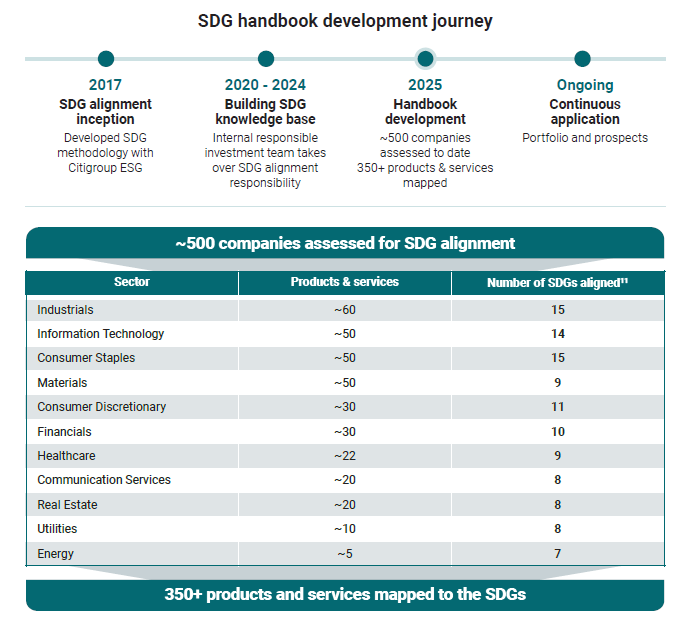
Our SDG alignment methodology has evolved since its inception in 2017, when Alphinity developed the concept to create the investment universe for the Australian Sustainable Share Fund with Citigroup. Since bringing this analysis in house five years ago, we have completed the SDG alignment for close to 500 companies. This extensive research has given us deep expertise in understanding how different industries and business models align, or misalign, with the Sustainable Development Goals.
At the end of 2025, we brought this rich dataset together to create our first SDG Handbook, a comprehensive reference tool that maps over 350 different products and services to the SDGs. This handbook will help to guide the positive and negative SDG alignment decisions for companies, strengthening the integrity and discipline of our sustainable investment process, while still allowing flexibility for company-specific nuances.

Defence investing framework
Enhanced due diligence tool and research project
In April 2024, we initiated a structured review to strengthen our approach to responsible investing for the defence sector. This work focused on refining our Weapons Policy and creating an enhanced pre investment due diligence (DD) framework for defence.
With rising geopolitical instability and rapid shifts in government defence strategies, it is important that we have structured processes to balance investment opportunities against ethical and reputational risks. Our enhanced DD framework, shaped by extensive company outreach and deeper policy refinement, creates a robust foundation for navigating this complex sector responsibly.
Since implementing this updated policy and due diligence process, we have:
Identified engagement priorities such as understanding how defence electronics firms like Codan and Motorola Solutions manage Board-level risks from UAV technologies used in dual applications and end-user controls. For component suppliers such as Amphenol, Parker Hannifin, and Howmet, the focus is on governance and oversight to prevent distribution to sanctioned areas or governments with poor human rights records.
Approved new companies to our investible universes across all funds. Howmet and Codan are provided as examples in the report.
Responsible financing framework
ESG and sustainability considerations for financial institutions
Responsible Financing Framework | ESG and sustainability considerations for financial institutions
In 2025, we expanded the scope of our Responsible Financing Framework beyond retail and investment banks to include other financial institutions, such as asset managers. Reflecting this broader application, the framework has been renamed the Responsible Finance Framework.
Originally developed in 2024, the framework was designed to strengthen our assessment of sustainability and ESG risks within large retail and investment banks, recognising the sectorโs central role in shaping economic outcomes through capital allocation and access to finance. During 2025, we refined and adjusted the criteria to ensure the framework is also fit for purpose when applied to other financials, including asset management companies.
Developed over two years, the Responsible Finance Framework addresses the complex interplay between governance, risk management and culture within financial institutions. It enables more targeted analysis of the most material ESG and sustainability issues and supports consistent benchmarking across institutions. The framework also provides a structured basis for assessing the suitability of financial companies for inclusion in our sustainable strategies.
The framework applies more than 40 qualitative and quantitative criteria, covering areas such as board effectiveness, non financial incentives in remuneration, ethical clawback mechanisms, risk controls, misconduct disclosure, controversy severity, and due diligence guardrails for high risk financing. Together, these elements provide a rigorous and holistic view of each companyโs overall ESG risk profile.
In 2025, we integrated the Responsible Finance Framework into our broader ESG and SDG Alignment processes. It was applied consistently in pre investment reviews and ongoing risk assessments for companies including DBS Group, Blackstone, NatWest and CaixaBank. All four companies passed our assessment, with DBS Group, NatWest and CaixaBank subsequently added as positions across our strategies.
Industry contribution
Continued focus on thought leadership, Climate Action 100+ and PRI Advance
Industry contribution | Continued focus on Climate Action 100+, PRI Advance and thought leadership
Established in 2010, Alphinity has steadily enhanced its responsible investment capabilities. We see stewardship as a broader part of responsible investing that goes beyond just engaging with companies or voting on proxies. It involves actively contributing to progress on important systemic issues that require collective action, like climate change or the responsible use of artificial intelligence.
For us, this has taken shape across five areas, each represented in the timeline below: becoming signatories to globally recognised frameworks and initiatives; holding memberships in leading responsible investment networks; participating in collaborative engagements; contributing to policy dialogue with government; publishing reports and developing frameworks as thought leadership; and presenting at industry conferences.
We are proud to continue actively supporting collaborative engagement initiatives organised by the UN PRI, the Investor Group on Climate Change (IGCC), FAIRR and HESTAโs 40:40 Vision.