



Corporate Australia just finished telling its story for the first half of CY26, and the short version is the numbers were fine, but almost nobody believed them. Across more than 190 companies that reported results, this season was defined less by what happened in the last twelve months than by what boards are willing to say about the next twelve. On that score, corporate Australia is nervous: earnings downgrades are outrunning upgrades into FY27, the consumer is softening, and even a reasonable beat ratio hasn’t translated into confidence.
That nervousness hasn’t stopped a rally. Several of the market’s most beaten-down names re-rated sharply through results, but not all of them earned it. Some moves were backed by genuine earnings upgrades; a good deal more were simply relief that results weren’t as bad as feared, a re-rating without the earnings support that would normally justify one. That distinction matters, because it’s easy to mistake a relief bounce for a turnaround.
Look past the aggregate and past the relief rallies and a handful of companies told a genuinely different story: results that ran directly against their own sector’s grain, for reasons that look durable rather than lucky. Three are worth a closer look.
Priced for perfection, delivering average/less bad than feared
ASX 300 earnings for FY26 are tracking toward growth of around c12% yoy. On the surface, a genuinely solid number, and the strongest in three years. But strip out mining and energy, and that growth falls to around 5.1%; strip out financials as well, and the rest of corporate Australia is growing earnings by something closer to 1-2%.
The market’s own scorecard tells a similar story. Of the 197 ASX300 companies that have reported, 32% have beaten consensus earnings by more than 5%, whilst only 16% have missed by more than 5%. A reasonable beat ratio on its face, but outlook statements are a different matter. Only 18% of companies guided FY27 expectations 2.5% ahead of the street, while 30% guided below and 55% kept guidance unchanged.
Overall ASX300 earnings growth surprised by 0.15% despite a sales miss, with margins doing the heavy lifting supported by lower costs, improved productivity, better mix and expectations that may have been cut too far since the Iran conflict started.
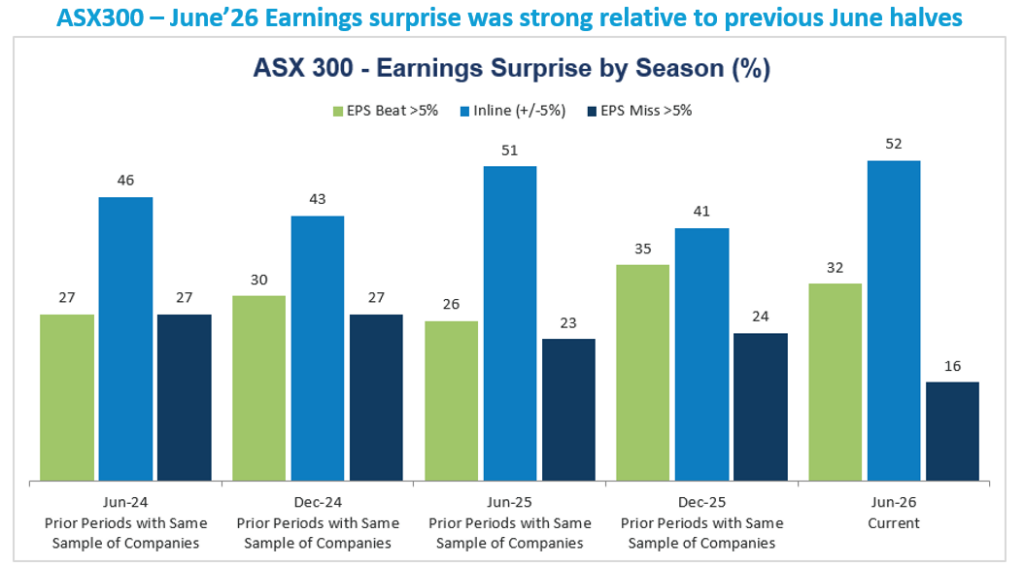
Source: Macquarie Research, FactSet, Visible Alpha, August 2026.
Earnings downgrades are persisting: In response, aggregate earnings for FY26 and FY27 have been downgraded by 1-2% over the reporting season, with 3 companies downgraded for every 2 that got upgraded. Across sectors, only Technology, Other Materials and Financial Services saw earnings upgrades, while Utilities, Metals and Mining and Energy saw the biggest downgrades. The momentum in forward earnings estimates has clearly flipped since the last results season back in February, going from a period of strong upward EPS momentum to now one of broad-based EPS downgrades.
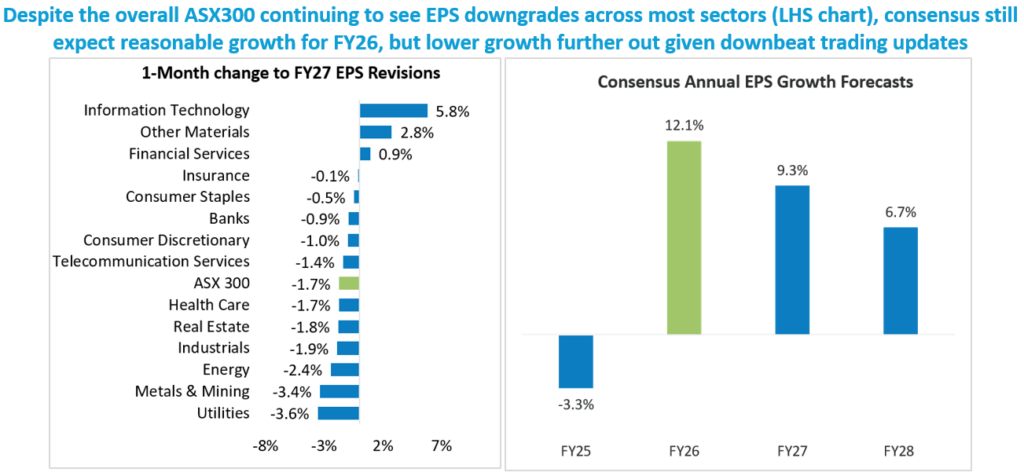
Source: Bloomberg, Morgan Stanley research, August 2026
Sector dispersion has been the real story
Beneath that uninspiring headline, performance has diverged sharply by sector. Global-facing Healthcare and Materials names were the best performers, while domestic facing Financials, REITs and Consumer Discretionary were the worst.
What’s notable is that rallies are not being confirmed by earnings. Materials’ strength had tracked the resources earnings upgrades carrying FY26 growth, but that support is now fading as the commodity-price tailwind that drove the sector’s upgrades earlier in the year loses momentum. Healthcare’s rally has run a little ahead of its earnings, too. CSL and Cochlear both delivered broadly in-line results with only small downgrades, and some of the sector’s move looks like relief that things weren’t worse, rather than a resumption of the earnings upgrades that would normally justify it.
More relief than belief. CSL and Cochlear are far from alone. UBS research captures just how widespread this pattern has been. Of the non-resources stocks that rose more than 5% on their results, 27 of 37 fell into the relief-rally camp: shares moving up not because the business was much better, but because results simply weren’t as bad as feared. Those 27 stocks rallied hard, up over 12% on average since reporting. But context matters: heading into results, this same group had already fallen more than 20% since the start of the year, so even after the bounce, they’re still down more than 12% year-to-date and analysts have cut their earnings by 0.5% on average.
The weak end of the ledger is more straightforward. The clearest casualties have been companies exposed to the slowing domestic consumer and softening housing market. Temple & Webster, JB Hi-Fi and Premier (Smiggle owner) all disappointed, with trading updates through August ’26 running below the growth rates seen back in February. Household spending is being squeezed by housing affordability pressure, elevated interest rates and a softening labour market, even as wage growth near 6% y/y keeps inflation pressure alive.
Underneath both of those stories sits a broader divide. Business lending, infrastructure, defence, mining services and data-centre investment all remained firm through results. The economy isn’t broadly contracting; it’s becoming increasingly divided. Growth is rotating away from consumer-funded demand toward business investment, including AI capex, with labour, components, power and funding now constraining that investment economy more than demand is.
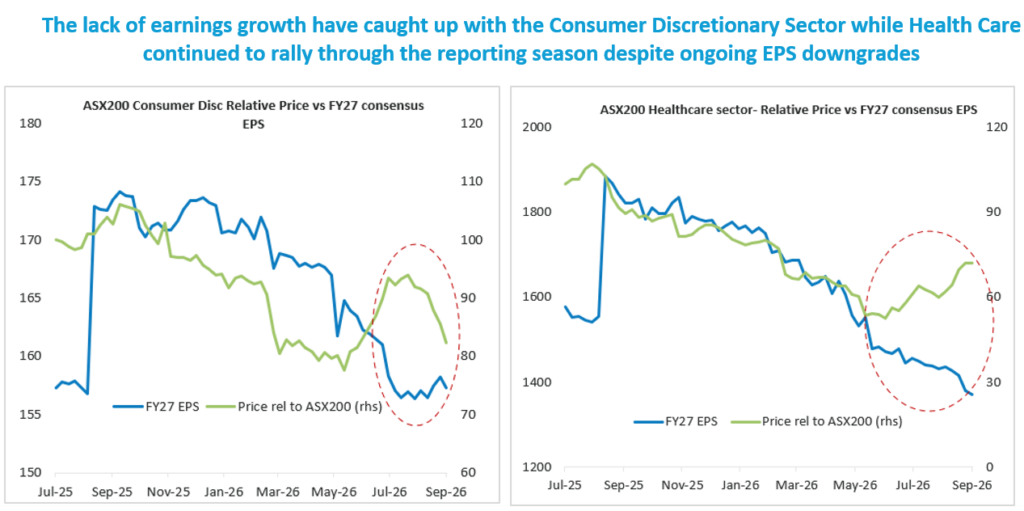
Source: UBS, LSEG, 31 August 2026
Balance sheets are strong, but growth spending is not the priority
Corporate Australia is sitting on healthy balance sheets, and for now that’s showing up in capital returns rather than a re-rating for growth. It was a record reporting season for buybacks with 23 new programmes announced worth roughly A$4.4bn, led by Telstra and CSL (A$1bn each), while a number of companies, including Suncorp, delivered the “golden hat-trick”: a dividend upgrade, a special dividend and a new buyback in the same result. Distributions were resilient despite the earnings downgrades, with companies beating FY26 dividend expectations and broadly maintaining FY27 expectations; BHP stood out, announcing its highest dividend in four years.
Capital deployment tells a more mixed story. Analysts have lifted FY27 capex forecasts for roughly two-thirds of non-financial reporters — spending is rising — but have simultaneously cut free cash flow expectations for the same cohort. More capex, less cash conversion: the market isn’t yet treating higher spending as a growth signal worth paying up for.
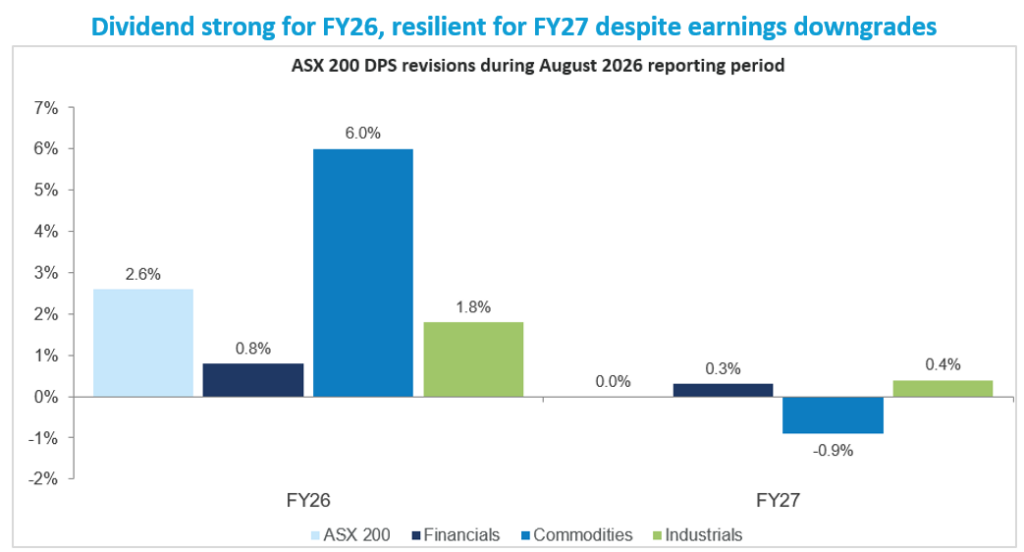
Source: Macquarie Research, Bloomberg, August 2026
AI has moved from a defensive topic to an offensive one
Around 60% of ASX-listed companies reporting this season discussed AI in their results commentary a new high-water mark, although the vast majority of the discussions still centres on productivity and cost efficiency rather than new revenue. The clearest earnings evidence remains in data centres, connectivity and hardware, while selected companies are also reporting measurable cost savings. But the build is increasingly capital intensive, making funding and revenue conversion more important. CBA’s disclosed A$200m of FY26 gross AI benefit is the clearest hard-dollar example to date, with REA, Carsales, SEEK and AMP also citing measurable gains.
Growing pains are also starting to show with many companies pointing to intensifying inflation pressures coming from memory, hardware costs (GPU’s & CPU’s), software licenses, AI compute, token costs, IT vendor costs and external technology providers.
Corporate Australia, in other words, has largely stopped asking whether it needs an AI strategy and started asking how much AI is worth to the bottom line, even if the honest answer, for most companies, is still “not much yet.”
3 companies bucking their industry’s trend
Against that backdrop of caution and consumer-led weakness, a small number of companies stood out this season precisely because they defied what was happening around them in their own sector/industry. Three are worth a closer look

AMP is one of Australia’s oldest financial services companies, providing wealth management, superannuation, and banking products to Australian and New Zealand customers. Its core businesses span retirement and investment platforms, superannuation and investment management, AMP Bank, and, increasingly relevant to the growth story, a pension and wealth partnership footprint in China.
A turnaround confirmed, not just claimed. AMP’s 1H26 result was arguably the clearest confirmation yet that its long turnaround has arrived. Underlying NPAT surged 33% and statutory NPAT climbed 57%, one of the group’s strongest half-year results in recent memory. Wealth management is the growth engine. Total AUM across Platforms, Superannuation and Investments, and New Zealand Wealth Management climbed 8.9% to $167.6bn, with Platforms net cashflows jumping to $3.1bn.
China is the underappreciated leg of the story. China Life Pension Company, now carried at $589m on AMP’s books, drove the bulk of a $56m China partnerships earnings line on its own, larger than the entire AMP Bank result for the half. Management frames China as a two-pillar opportunity: an established Pillar 2 pension business addressing a market north of 100 million people, and a nascent Pillar 3 opportunity addressing more than half a billion citizens. See chart below.
Capital return is accelerating. AMP continues to free up capital, returning it to shareholders through bigger dividends and buybacks. Just as importantly, management says the simplification journey is now complete — legacy issues largely resolved, the cost base reset, the sales team rebuilt, and customer reputation scores at their strongest since tracking began in 2008. The lingering drag: AMP Bank. Now the anchor on group returns for a third consecutive half, as the group works to shift its funding mix and eventually free up capital to redeploy into the higher-returning wealth business.
What’s next: After a decade of fixing what was broken, AMP now gets to build what’s next. Importantly the funding mix at AMP Bank needs to shift before that capital can be redeployed into the higher-returning wealth business. Two engines are already running. The stock needs the anchor lifted.
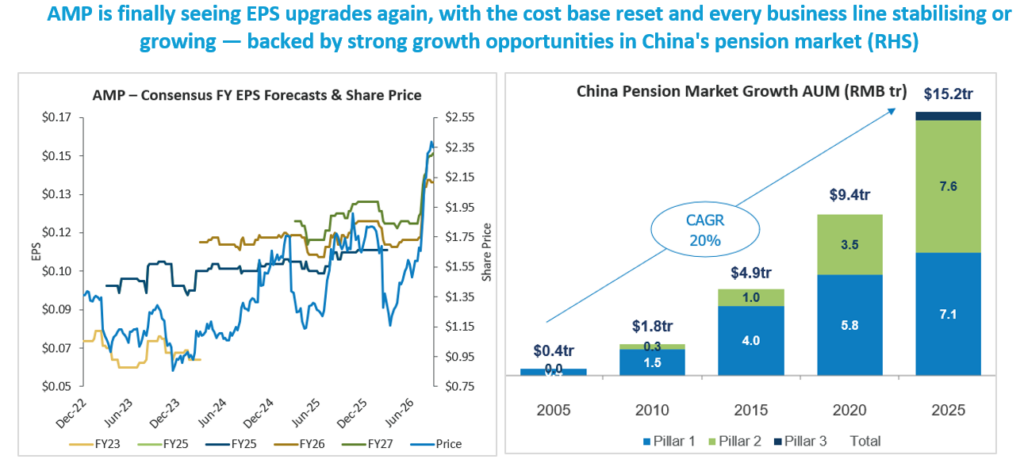
Source: LHS: Bloomberg, August 2026. RHS: AMP 1H26 Results

James Hardie is a global building products manufacturer specialising in fibre cement for exterior and interior applications, used in new residential construction, manufactured housing, repair and remodelling, and commercial/industrial applications.
1Q27: A beat, and a raise. JHX beat both revenue and adjusted EBITDA expectations and lifted FY27 guidance. The result was underpinned by execution, not a stronger housing market. The AZEK integration is ahead of plan: early revenue synergies are already showing up, with Hardie’s distribution network now selling AZEK’s recycled decking (a genuine timber alternative) into the same builder relationships, particularly strong in the North-East and Midwest. AZEK has also transformed the revenue base, pushing JHX beyond fibre cement siding into exteriors and outdoor living.
Since then: sharpening the portfolio. JHX has agreed to sell its European Fermacell business to Holcim and intends to close its European fibre cement operations to concentrate on North America, its highest-growth, highest-return market. The ~$600m of proceeds will go straight to debt paydown, accelerating the path to sub-2.0x net leverage and fund an additional $250m buyback. Cleaner balance sheet, better margin mix, more capital back to shareholders.
The demand backdrop is still the swing factor. US new residential construction remains challenged, and management frames demand as “K-shaped”, concentrated at the top end, among households whose confidence (and portfolios) have held up best. With Siding & Trim ~65% of group revenue, that end-market matters enormously. Management is calling for a return to organic Siding & Trim growth in FY27, and while the market hasn’t confirmed it yet, early signs in repair-and-remodel look promising.
What’s next: commercial synergies move to centre stage: supply chain and channel strategy, manufacturing efficiency, and the payoff from combining sales forces and expanded distributor relationships. The setup for a re-rating is simple: execution + synergies + a market recovery. Two of three are already running. The stock needs the third.
CFO Ryan Lada: “Our first quarter results came in ahead of expectations, and that outperformance was driven through synergy realization, our enhanced go-to-market model, and the manufacturing cost actions we took in FY26, not a shift in the underlying housing market.”
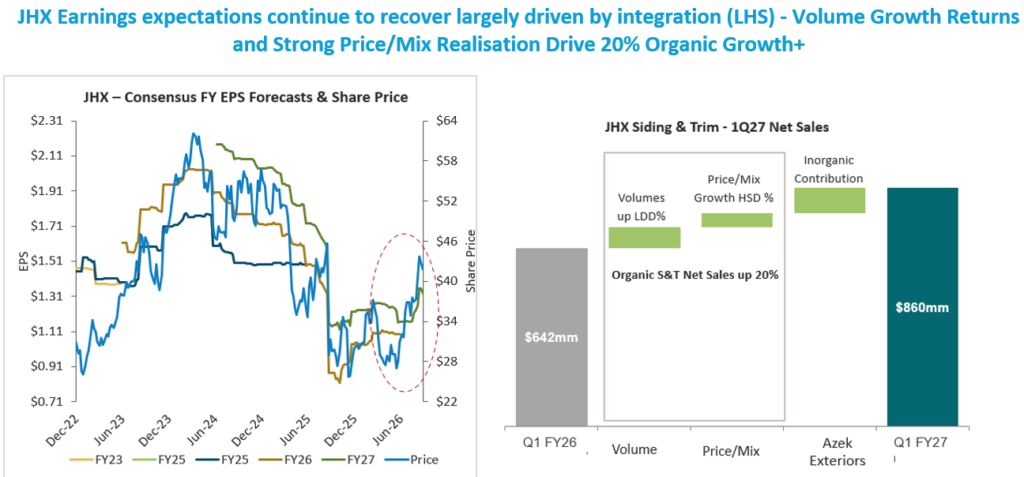
Source: LHS: Bloomberg, August 2026. RHS: James Hardie 1Q27 Results

Ansell is a global leader in protective solutions, manufacturing gloves, clothing, and personal protective equipment (PPE) for two core end-markets: Healthcare (medical and surgical gloves) and Industrial (protective wear for manufacturing, chemical, mining, and other high-risk work environments).
A result that showcased pricing power, not just volume. Ansell’s FY26 result stood out for what it revealed about management’s ability to navigate a genuinely hostile cost and trade environment and simply raise prices to cover it. Group sales and NPAT both beat street expectations and FY27 guidance points to adjusted EPS growth of 8% ahead of the street, alongside $30m of lower capex. Healthcare margins expanded to 14.3% and 2H26 volumes accelerated to 9.2%, signalling a return of volumes.
The backdrop makes the result more impressive, not less. Ansell manufactures a large share of its gloves in Thailand and Malaysia squarely in the crosshairs of US tariff exposure and has chosen not to relocate production. At the same time, Middle East conflict has pushed up the price of nitrile, a key oil-derived input, compounding tariff-related cost pressure and supply chain complexity. The playbook: price increases plus cost-out, executed at scale. Ansell’s response has been to raise prices globally while running a series of internal cost-out programs to protect and grow margin. A combination that’s far easier to describe than to execute, and one that has clearly worked for Ansell this season.
What’s next: pricing and cost-out have already done the heavy lifting. The next test is whether the new management team can keep the same playbook running without missing a beat.
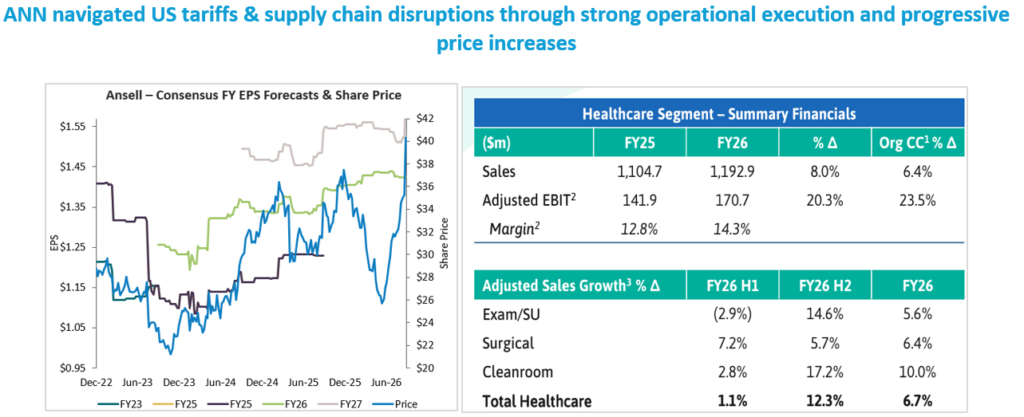
Source: LHS: Bloomberg, August 2026. RHS: Ansell FY26 Results
Summary
None of AMP, James Hardie or Ansell sit in a sector/industry the market currently loves. Financial services, US housing materials and industrial manufacturing have all drawn scepticism this reporting season, for reasons that are individually well founded. What connects the three is that each delivered a result meaningfully better than its own sector/industry’s trend, and for company-specific reasons that look built to last: AMP’s multi-year simplification finally bearing fruit, James Hardie’s AZEK integration genuinely working even as its end market lags, and Ansell’s pricing discipline holding under real tariff and input-cost pressure. That distinction, durable execution versus a bounce on low expectations, is this reporting season in miniature. Most the market’s best share-price performers this season were relief, not belief: results that weren’t as bad as feared, re-rated by a market pricing in the worst, with almost nothing to show for it in the earnings themselves. The aggregate numbers say the market is right to be cautious: a slowing consumer, a softening housing market, downgrades outrunning upgrades. But underneath that caution, company-specific execution is still getting rewarded. After a season this full of relief rallies, the names where the earnings actually did the work, are the ones worth a second look.