



The market has stopped applauding just earnings, it also wants cash flow and proof that AI spend is paying off — and it’s rewarding a broader set of winners while it waits.
Global reporting season just delivered one of the strongest quarters in years with a strong beat rate and aggregate growth across most regions and sectors. And critically, that growth is no longer a mega-cap monologue: ten of eleven S&P 500 sectors posted positive growth, eight in double digits, with Energy, Financials and Industrials delivering beats of their own. Yet by any historical yardstick this was a phenomenal season, share prices, especially in Tech, have barely moved and in some cases have even fallen. This disconnect is an important shift in the AI story. Investors have rewritten the scorecard: it’s no longer enough to ‘just’ beat, there also needs to be line of sight to sustainable AI monetisation, healthy margins and strong cashflows. Companies that cleared the higher bar were rewarded, while those that didn’t were often punished despite a headline beat. And increasingly, that reward is flowing to names outside the usual Tech leadership.
The Numbers
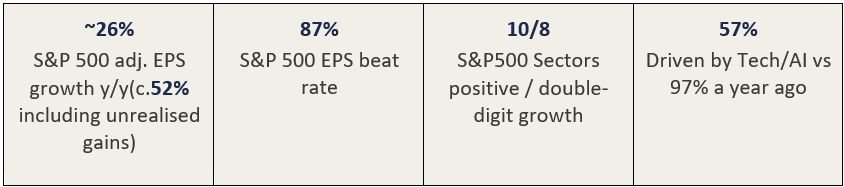
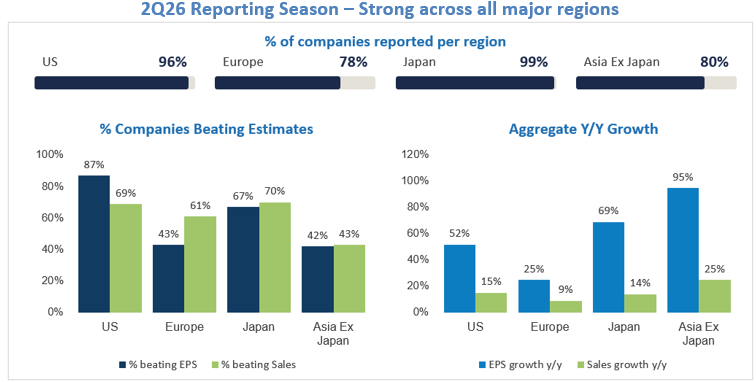
Delivery was exceptionally strong. Earnings delivery for 2Q26 was outstanding, with positive EPS surprise across all regions and a solid breadth of beats. Not only did the proportion of companies with both top and bottom-line beats rise sharply, the positive EPS guide-ratio rose to a post 2021 (Covid recovery) high. a post COVID recovery high.
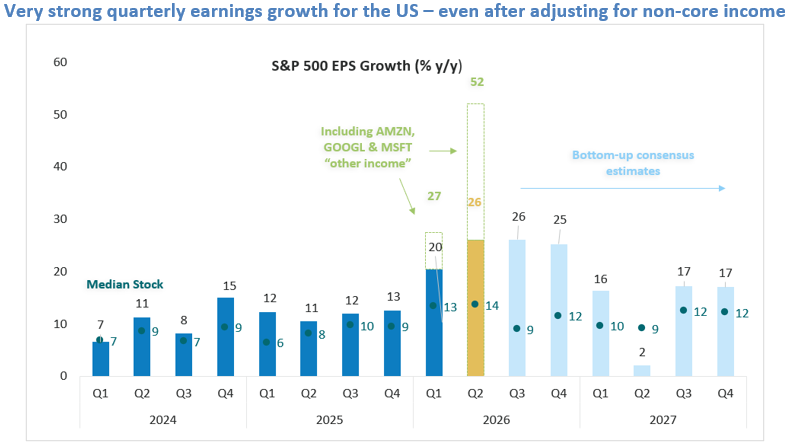
Regionally, the gap between US and European EPS growth has narrowed meaningfully, now in line at both at an aggregate level (c.26% ex AMZN, MSFT, GOOGL other income) and at a median level (12%), with Japan and Asia ex-Japan well ahead of historical growth levels.
Source: Bloomberg, 27 August 2026
The earnings base is broadening, not just growing. Tech and AI remain the largest contributors to S&P 500 earnings growth, but their share of that growth has narrowed from ~90% a year ago to ~57%. Ten of the 11 S&P 500 sectors are on track for positive earnings growth, with 8 in double digits, which is a dramatic improvement on 2Q25, when only two sectors managed positive growth.
Winners outside Big Tech. Energy, Financials and Industrials are delivering solid, resilient beats of their own, driven by higher commodity prices, tight energy markets and improved net interest income and yield opportunities.
Earnings strength is no longer confined to a narrow group of mega-cap stocks, with broader participation at the median-stock level noticeable, coupled with improving earnings revisions breadth.
Source: Goldman Sachs data, Bloomberg, 27 August 2026
How the Market Has Reacted
Despite the generally strong earnings reported, share-price responses have been muted and, in some cases, have even corrected lower. This likely reflects a combination of elevated expectations, crowded investor positioning in the sector, and an increased focus on capex commentary. The same scrutiny of cash generation and AI returns flagged above is now playing out in real time at the stock level, rewarding proof over promise.
Broadening market leadership — value and cyclicals ahead of Tech
- Broadening away from AI and AI adjacent stocks. Tech and semiconductor pullbacks have driven a noticeable rotation, with equal-weighted indices and Value benchmarks outperforming Growth.
- The “high bar” disconnects. Solid double-digit earnings growth is no longer a guaranteed share-price catalyst with investors are punishing high-valuation Tech names on even small misses, slowing momentum, or an unclear return on capital.
- Severe post-earnings volatility. Announcement-day reactions have been unusually wide, with modest misses triggering outsized, multi-percentage-point selloffs against a backdrop of tight credit spreads, high rates and crowded positioning.
- Free cash flow over EPS. The market is increasingly rewarding durability, cash conversion and operating efficiency. Stocks with upward revisions to both EPS and free cash flow have outperformed post-reporting by 1.6%, versus -0.2% for EPS beats unaccompanied by FCF upgrades.
- AI efficiency, not just AI exposure. According to research done by Goldman Sachs, companies screening as genuine AI adopters/efficiency beneficiaries are outperforming peers that are simply spending on AI.
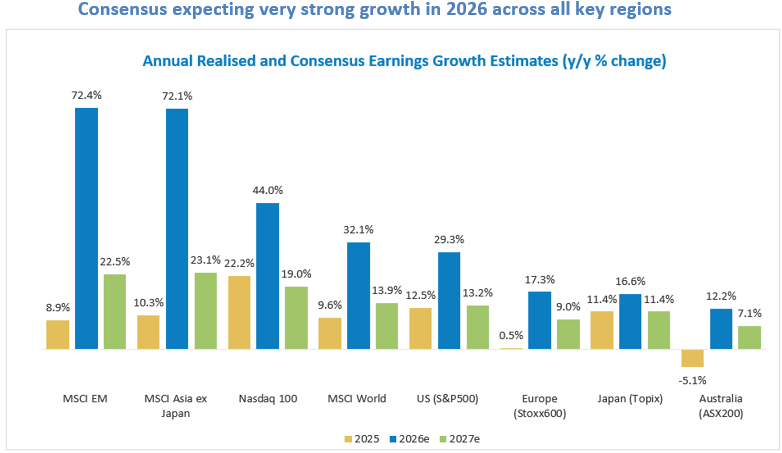
- Earnings have been upgraded across all key regions and most sectors over the past month with all major regions expecting strong 2026 and 2027 growth.
Source: Bloomberg, 27 August 2026
Key Themes Playing Out
1. The AI capex supercycle – stronger but not for free: The underlying AI metrics keep strengthening; cloud revenue growth at the hyperscalers has accelerated to now approach 50% yoy, cloud backlogs are approaching $1.7trillion and the annualised revenue run-rates (ARRs) at the leading AI labs continues to inflect. Meanwhile the whole AI supply chain is talking of severe capacity constraints as it struggles to expand capacity quick enough to catch up with this rampant demand.
However this growth, and projections for its continuation, does not come without a cost. To support this growth capex across the hyperscalers will exceed $700bn in CY26, up from $150bn just 3yrs ago. And forecasts are for capex to exceed $1tr next year. This is driving the free cash flow for some of the most cash generative businesses in the world to turn negative, and for alternate funding structures to support the build out to begin to emerge.
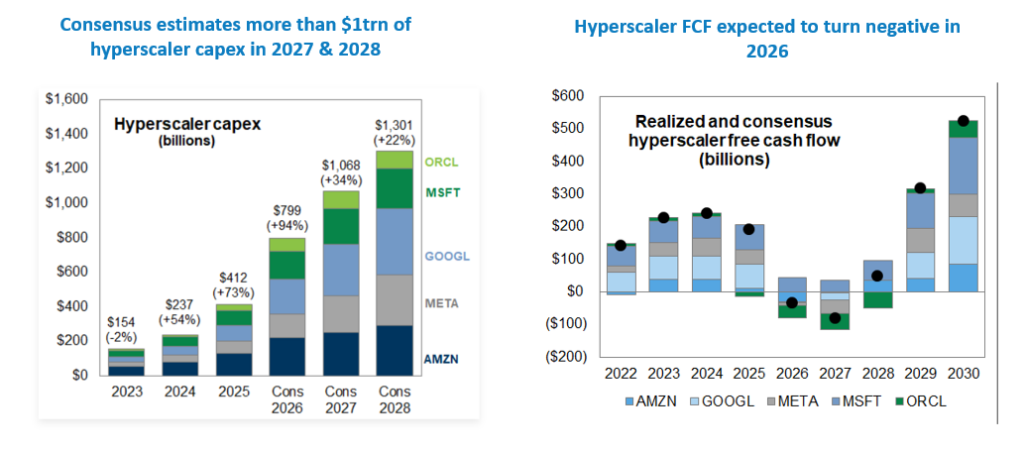
Source: GS Research, August 2026
The key question is the subsequent return that can be generated on all of this investment, and the timing for it to emerge. There is undoubtedly a chasm that must be crossed, as evidenced by the emergence of what has loosely been called “circular financing”. Hyperscalers and compute providers such as Nvidia and Broadcom are investing in the leading labs, while also providing investment support for compute, with these funds then used to procure products and services from these investors. Is this a classic late-cycle excess or a sensible financing bridge until these leading labs reach sustainable scale? Then the return argument; Amazon outlined a compelling ROIC argument with their recent 2Q results but these returns in the end will be defined by the value created through the adoption of AI – which is building quickly but remains at an early stage.
We sit at a fascinating juncture with AI and given the current stage of the investment cycle, need to be measured and selective with out exposures within it.
Amazon’s Q2 commentary is the clearest articulation yet of the bull case for why the spend still pays off: AI servers break even in under 3yrs against a 5-6 year useful life and largely 5-year contracts, leaving in Amazon’s words: “significant free cash flow in the 2-3yrs after we break even” with returns “tracking what we saw with core cloud at the same point of evolution, actually a little ahead.”
2. Financials — trading, fee income and rate leverage. Banks delivered another strong quarter, with several tailwinds converging. Investment banking continued to rebound, with double-digit fee growth across major firms on the back of an IPO and M&A resurgence, while elevated volatility from tech-sector swings and Middle East tensions drove strong trading revenue. A steepening yield curve and disciplined deposit pricing let several large lenders raise or reiterate net interest income guidance, even as commercial loan growth stayed modest on higher borrowing costs. Wealth and asset management added another leg, with buoyant markets driving strong inflows and record AUM levels. Credit quality has held up well overall, although banks remain cautious about lower-income consumers and pockets of commercial real estate. Underneath it all, continued cost discipline and growing use of AI in back-office and compliance workflows are helping protect margins, rounding out a quarter where nearly every lever pulled in the sector’s favour.
3. Industrials, energy, commodities and the power build-out — one connected story. Elevated commodity prices supported energy and materials earnings, while the broader industrial and infrastructure complex is being lifted by the same structural driver: electrification and data-centre power demand. Utilities are reporting hyperscale interconnection pipelines running well ahead of formal guidance, industrial demand from high-tech and data-centre customers is accelerating, and construction, equipment and rental names are citing record backlogs tied directly to power-generation and grid build-out. Turbine and grid-equipment order books are outrunning near-term supply and regulated-growth utilities are compounding through bolt-on network acquisitions. This broadening of the beat-and-raise cycle well beyond technology into rails, rentals, utilities and industrials is one of the more encouraging signals of the quarter.
4. Consumer — a widening split between affluent and mass-market. Mass-market and value-oriented consumer names are citing tightening household budgets and a more cautious shopper, with several guiding down on softer volumes. Luxury, by contrast, is recovering with organic sales growth accelerating from the prior quarter and demand polarising toward brands with genuine pricing power and affluent-consumer exposure. Payments and travel spending data continued to point to firm underlying consumer activity, a reminder that the softness is concentrated rather than broad-based.
Coca -Cola: “On the consumer front, what we’re seeing is while they remain participating in the industry, the lower income continues to be pressured, and we’re seeing that it’s really about value, not only pricing.“
5. Geopolitical and macro headwinds. Escalating Middle East tensions pushed oil to a one-month high and triggered a bout of semiconductor volatility; China’s ongoing slowdown continues to weigh on autos and other China-exposed sectors as local competitors take share; and isolated guidance misses in life sciences and other defensive sectors were punished hard, a reminder that the market’s patience for disappointment remains thin even in a strong season.
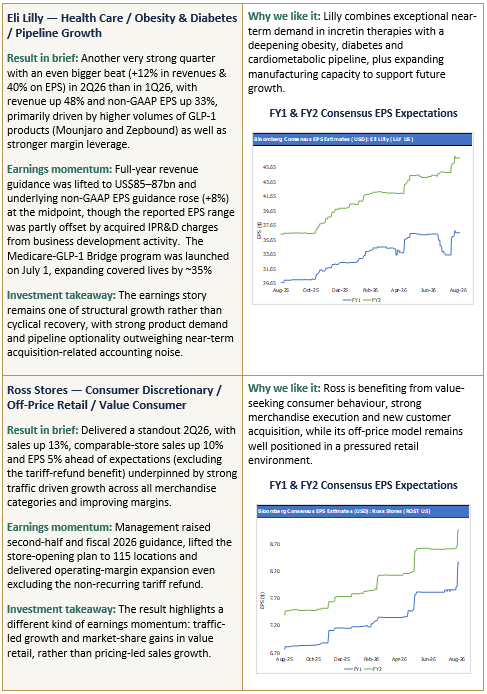
Standout Results across sectors, themes & regions
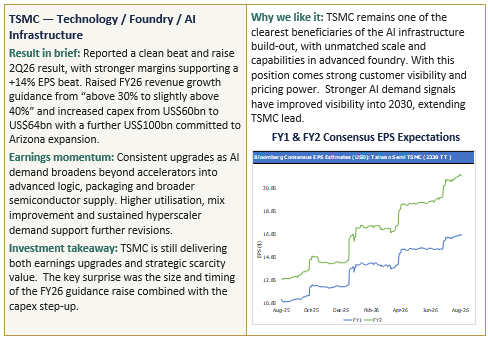
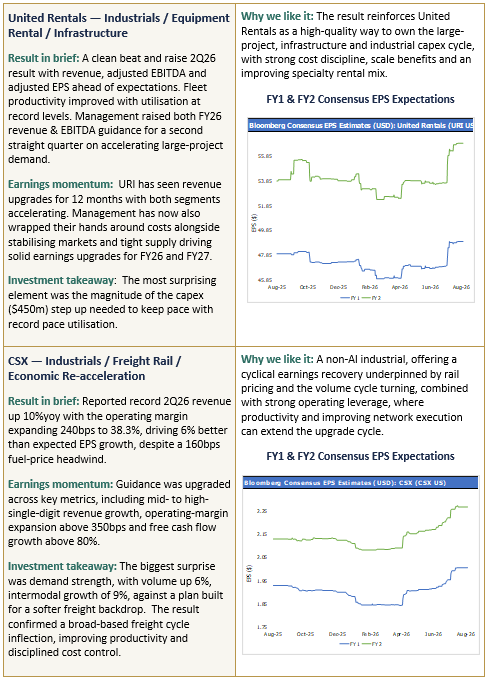
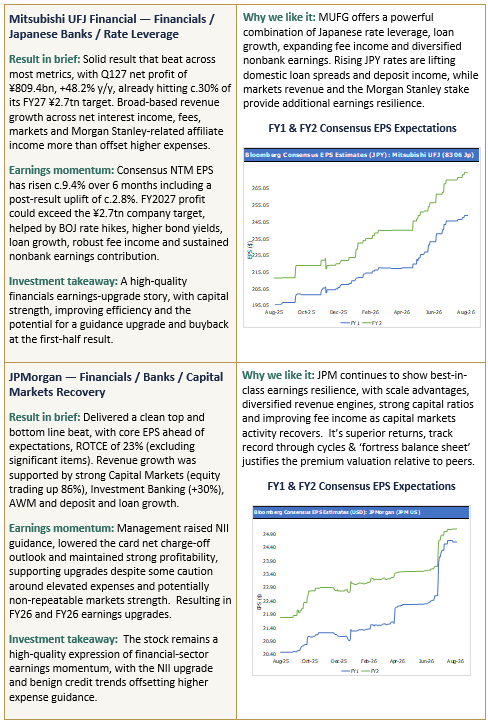
Conclusion
Beats everywhere, belief nowhere. That’s 2Q26 in five words. The delivery was real, a broad, deep earnings recovery, no longer a mega-cap monologue. But the market has moved the goalposts: it’s paying for proof, not just growth, pricing quality of earnings over quantity and punishing capex-heavy stories without a visible payoff.
That repricing is the story to carry into 3Q26. Key things investors will need to keep an eye on include: whether hyperscaler capex guidance keeps climbing and returns keep improving; whether the 2% of companies quantifying an AI earnings benefit becomes 5%; and whether this quarter’s broadening beyond Tech and mega-caps proves durable rather than borrowed. The earnings backdrop has rarely looked better, but the patience for paying up on promises has rarely looked thinner. We continue to focus on finding companies that can bridge the gap and deliver fundamentally driven earnings surprises.